Are Porn Sites Safe? What Actually Puts You at Risk in 2026
The short answer
Mostly yes, if you stick to established sites and never install, paste or call anything a page tells you to. In 2026 the risk rarely comes from a site's own pages. It comes from the ads around them, fake copies of famous sites, old account leaks that feed blackmail emails, and where your viewing and ID data ends up.
Where the risk sits in 2026
Most of what you'll find on this question is old. The pages that rank for it lean on figures from 2013 to 2018, rarely name a real campaign or leak, and stop before telling you what to do. We went back to the documented cases instead, and every number below carries its year.
To keep it concrete, follow one evening. Alex isn't a real person, but every trap he meets comes from a documented case. He opens a free tube he has used for years, clicks play, and a second window jumps up. Later he searches for another site by name and clicks the first result. A week after that, an email arrives with one of his old passwords in its first line. And on his next visit from the UK, a page asks him for a selfie.
None of that starts with a hacked video page. It starts with an ad, a fake address, a leak from years ago and a form, and each one has its own fix.
Can you get a virus from a porn site?
You can, but in the documented cases on big sites the visitor had to do something first, and the way in was the advertising.
In October 2017, Proofpoint described a group it called KovCoreG that had run bad ads on Pornhub for more than a year through TrafficJunky, the ad network behind the site. The ads screened visitors by country, internet provider and browser details, showed a harmless decoy to anyone who didn't fit, and offered the rest a fake "critical update" for Chrome, Firefox or Flash. The victim had to open that file, Proofpoint stressed, because the chain used no exploits. It counted millions of potential victims in the US, Canada, the UK and Australia: people who could have seen the ad, not confirmed infections. Both companies shut it down once told.
Three years later the same route carried a different trick. Malwarebytes found that from November 2020 to February 2021, clicking play on Pornhub, YouPorn or RedTube could open a new window that pulled an ad from TrafficJunky, the advertising company behind those sites. That ad passed through one of about 100 decoy dating sites and ended on a full-screen fake Windows Defender scan. That's Alex's second window.
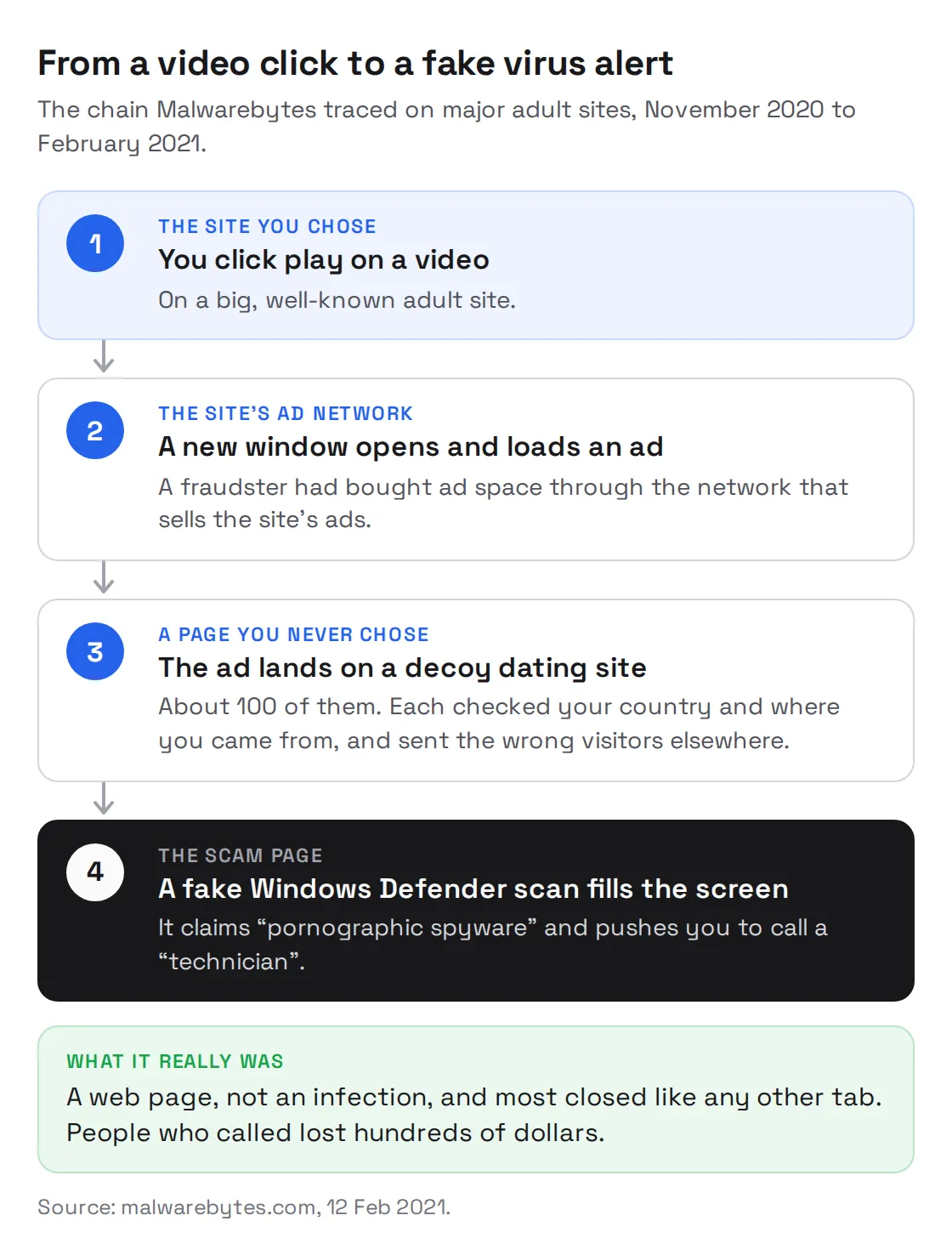
What saved most people is that the scary page was only a page. Malwarebytes notes that these lockers are fake warnings and that most of them close normally. The FTC's guide to tech support scams puts the rule in one line: real security warnings "will never ask you to call a phone number." Those who did call were taken for hundreds of dollars, Malwarebytes says.
So a famous site isn't automatically clean, because its ads come from whoever bought the space, and that matters most on free tubes, which live on advertising. But in both cases saying no was enough: no file opened, no number called. An up-to-date browser and operating system cover the rare attack that needs no click at all.
Fake copies of famous sites
The newer danger is a site that only looks famous. In November 2025, Acronis's research team described fake copies of xHamster and Pornhub built to infect their visitors. On these clones any click, or a yes to "allow notifications", turned the browser full screen and showed a convincing Windows Update. The fake update told the visitor to paste a command into the Windows Run box, then kept asking for administrator approval until it got it. What it installed were programs that steal saved passwords and other data, and a single infection ran eight malicious programs at once.
Acronis couldn't say how victims found the clones. It suspects ads and pop-ups on shady sites but hadn't tied them to a campaign. What it could say is that people chose to visit, and that's the part Alex controls. When he searched by name and clicked the first result, he trusted a search box to know which address was real.
The fix is old and dull. An FBI alert from April 2020 already told people to type a site's address themselves rather than follow a link to it, and a bookmark does the same job. No real video site needs you to paste anything into Windows, and Windows updates don't arrive through a web page. And if a site asks to send you notifications, say no; Google's help page shows how to stop every site in Chrome from asking.
Alex closes the fake update without pasting anything. The next scare arrives by email.
Is the "I recorded you" email real?
No. The email Alex gets a week later says the sender hacked his computer, filmed him through his webcam while he watched porn, and will send the video to everyone he knows unless he pays in Bitcoin within a day or two. It opens with a password he recognises, and that's what makes it land.
The same FBI alert from April 2020 describes this email, and its list of warning signs reads like Alex's inbox.
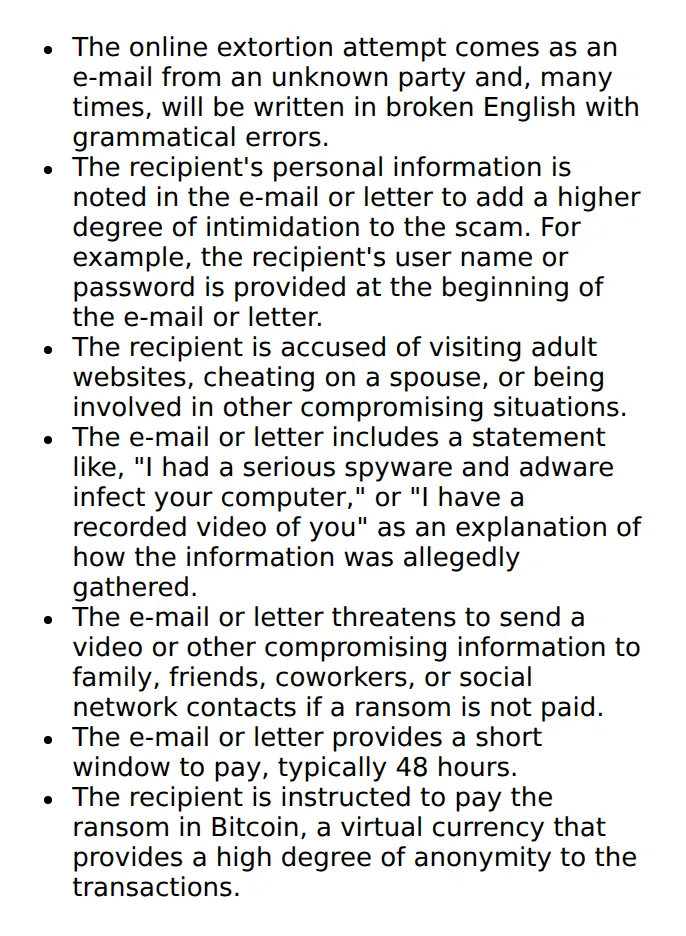
The FTC's alert from the same month is blunter: "Stop. Don't pay anything. Delete the message. It's a scam." The claims about webcams and clever software, it says, are "all talk." The FBI adds that you shouldn't reply at all and that it does not condone paying.
Newer versions add props. In September 2024, Krebs on Security reported emails that included the recipient's full name and a photo of their house, apparently lifted from an online map, with a demand of just under $2,000 in Bitcoin within 24 hours. The photo shows that someone knows where you live, not that anyone has seen your screen.
There is a real threat close to this one, and it works differently. In August 2026 the FBI warned that criminals break into social media and other personal accounts to steal intimate images, then post or sell them. They get in with passwords from old leaks, fake support texts asking for a login code, and fake "new login" emails. The FBI's advice: a unique passphrase, two-step login, no sharing of codes you didn't ask for, and no such images in accounts that live online.
Which leaves Alex's real question: where did they get his password?
Where the password in that email came from
From a leak, usually an old one. The FTC's alert says these scammers may really know one of your old or recent passwords because your email was exposed in a data breach. For adult sites, Have I Been Pwned (HIBP), the free service that tracks published breaches, shows how far back that goes.
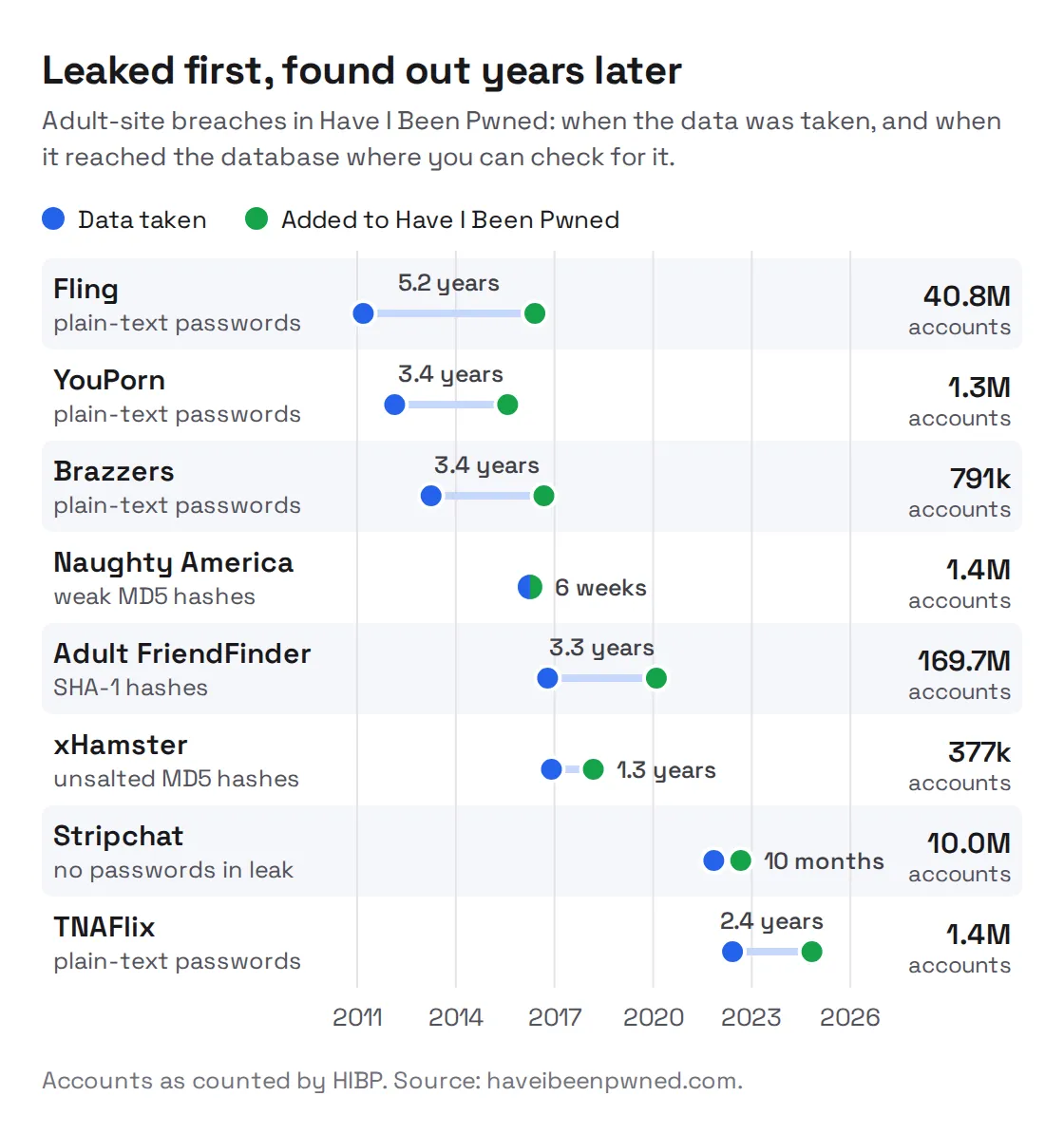
Two things in those records matter for Alex. The first is how badly passwords were kept. Fling (2011), YouPorn (2012), Brazzers (2013) and TNAFlix (2022) leaked them in plain text, ready to use. Others used old, fast scrambling methods; HIBP calls Naughty America's "easily crackable". A password Alex set on one of these sites in 2012 still opens his email today if he used it there too.
The second is the delay. Brazzers was hacked in April 2013 and the breach only came to light in September 2016. Adult FriendFinder's October 2016 breach, 169.7 million accounts, reached HIBP in February 2020. Fling's 2011 leak took more than five years to get there, and TNAFlix's 2022 data arrived in 2024. A leak you have never heard of can still be circulating.
HIBP flags adult-site breaches as sensitive, so typing your email into its public search won't show them. Its FAQ explains the way round it: you sign in with that address and confirm you can receive mail there, and the sensitive breaches appear in your own dashboard.
Several of these names are on our own list today. Stripchat, xHamster, YouPorn and Brazzers all carry a B. Our grades judge how a site runs today, and a breach is history. A B now doesn't undo a leak from 2016 or 2021, and an old leak on its own says little about how the site is run now. You need both facts.
What sites learn about you without any hack
Plenty, and most of it leaves by design. A password can be changed. A record of what Alex searched for can't.
The largest study we found is a March 2018 crawl of 22,484 porn sites by Elena Maris, Timothy Libert and Jennifer Henrichsen. It found that 93% of them sent visitor data to at least one outside company. Google's services were on 74% of the sites, Oracle's on 24% and Facebook's on 10%. For nearly 45% of the sites, the web address alone pointed to a specific sexual interest or identity that could be tied to the visitor. A second team looked at 6,843 sites for a 2019 study: 72% set third-party cookies, only 16% had a privacy policy you could find, and 4% asked for cookie consent. Both are snapshots from 2018 and 2019, not today's numbers.
A December 2025 case shows why it still matters. Aylo, Pornhub's parent company, said "a limited set of analytics events" about some Premium members had been exposed through its analytics supplier, Mixpanel, with no passwords, payment details or IDs involved. Mixpanel said it found no sign the data came from its systems. The criminals who claimed the leak said it held search and watch histories. The Register reported both sides, and the blame is still disputed. The kind of data isn't: a record of activity, held by an outside company.
Private browsing doesn't change this. About half (52%) of active UK porn users say they "always" use it, according to a survey in Ofcom's July 2026 report on age checks. But Google's own help page for Chrome's Incognito mode says the websites you visit, and whoever runs your network, like an employer or internet provider, may still be able to see your activity. Incognito keeps your history off your device, and that's all it does.
And since 2025, UK visitors hand over one more piece of data before they see anything at all.
Is age verification safe?
It can be, and how much you hand over depends on the method you pick.
Under the Online Safety Act, porn sites serving UK users have had to check that visitors are adults since July 2025. Ofcom's report counts over 69 million age checks between July and December 2025 across 32 services it sampled, and says all of the UK's top 10 porn sites and most of the top 100 now have them. In the US, the Supreme Court upheld Texas's age-check law for porn sites in June 2025 (Free Speech Coalition v. Paxton).
Alex's selfie request is the most common kind. Facial age estimation made up 68% of completed checks on the porn services Ofcom analysed between July and November 2025. Every one of those services offered more than one method, three on average, and almost all handed the check to an outside company. Several said that company passes back only a pass or a fail. One said its face check keeps the image and any ID document for up to an hour.
The worry is still fair. Ofcom cites a case Discord disclosed in October 2025, in which about 70,000 users may have had government ID photos exposed through 5CA, an outside support company that reviewed age appeals. In Ofcom's own survey of porn users, carried out in autumn 2025 and early 2026 and skewed towards men, eight in ten said they'd be uncomfortable proving their age with a credit card. Ofcom also found that some sites without checks have gained visitors. A site that ignores the rules where it has to follow them is a poor place to leave an email address or a card number.
So pick the method that ties the least to your name, a face estimate or an email check rather than a passport upload, wherever the site offers the choice. Look for the name of the company running the check. And treat a check that appears on a page you reached through an ad or a pop-up as a reason to leave, not a hurdle to clear.
How to tell a well-run site from a risky one
Most of it is visible before you sign up or pay. The warning signs are the moments from Alex's evening: a page that wants a file installed, a command pasted or a number called, an address one letter off the one you know, a notification prompt on your first visit. A well-run one is duller.
It says who runs it and who bills you
A well-run site names the company behind it, publishes its terms and privacy policy, gives you a way to report content and tells you who handles billing. That last part helps most when something goes wrong, because the line on your card statement can carry the biller's name rather than the site's, as CCBill explains for its own charges. New Sensations, which we grade A, names Epoch and Segpay as its billers, so you'd know who to ask.
It sells tokens, not a trial that renews
Many paid networks keep the trial length and the price it renews at behind the join button. Adult Time, a B on our list, is one of them. Read the trial terms before you type in a card number, and if you can't find them, assume the trial renews. On Chaturbate you buy tokens, and a token purchase is a one-off charge: you pay for what you buy, not for a month you forgot to cancel.
It doesn't need your details at all
The account you never open can't leak. Thumbzilla, a B on our list, asks for no login and no payment, and most free tubes are the same as long as you don't sign up. Free sites are paid for by ads, so everything above about new windows and prompts still applies.
If you do sign up somewhere, use an email address you use for nothing else and a password you use nowhere else. Then a leak, when it comes, exposes a spare inbox rather than your name.
If something already happened
Act on what actually happened, not on what the page or the email claims.
- You called the number or let a "technician" onto your computer. Hang up. If you gave them a password, the FTC says to change it right away; do the same for your email and any password you reused. Then check your card and bank statements for payments you didn't make. In the US you can report it at ReportFraud.ftc.gov.
- You ran a file or pasted a command. Treat every password saved on that computer as stolen, since that is what the 2025 programs went after. From another device, change your email and banking passwords first and turn on two-step login, then get the computer cleaned or reset.
- You got the "I recorded you" email. Don't reply and don't pay. If the password in it is still in use anywhere, change it there. Report the email at ic3.gov with its full header and the Bitcoin address.
- Intimate images were taken from one of your accounts. Lock the account with a new passphrase and two-step login, and report it to the FBI at ncii.ic3.gov.
- There's a charge you don't recognise. Ask the biller first. CCBill can find a purchase from any two of your email, card number and transaction details, and Epoch has a Find My Purchase page. If that gets you nowhere, go to your card company.
Then do the thing that would have helped Alex most: sign up at HIBP with every address you've ever used on an adult site, so the next old leak reaches you before a blackmailer does. Alex, for the record, closed the window, pasted nothing, deleted the email and changed an old password that still opened his inbox. None of it needed special software, only knowing which pages to ignore. Before you sign up anywhere new, look the site up on our list first.
Frequently asked questions
Does a VPN make porn sites safe?
A VPN hides which sites you visit from your internet provider and the network you are on, and hides your home connection from the site. It does nothing about a bad ad, a fake copy of a site, or what a site records once you log in or pay. Treat it as privacy from your network, not protection from the sites.
Can a porn site turn on my webcam?
Not without your permission. Chrome asks before any site can use your camera or microphone, and you can block them for every site in its privacy settings. The FTC calls the webcam claims in blackmail emails all talk. Only allow a camera on a cam site where you broadcast yourself.
Are paid porn sites safer than free ones?
Not automatically. Paying means handing over an email address and card details, and paid networks have leaked too: Brazzers stored its members' passwords in plain text when it was hacked in 2013. A free site you use without an account holds less about you. Judge the operator instead: a named company, a named billing company and renewal terms you can read before you pay.
Is watching on a phone safer than on a computer?
Somewhat, for the tricks covered here: the fake updates and paste-a-command pages targeted Windows computers, and only the 2021 fake scan also came in a Mac version. Leaks, tracking and blackmail emails have nothing to do with your device, though. A phone needs the same habits: install nothing a page offers, call no number on a warning and use a different password on every site.